
Interactive Presentations
Fable 5.2
Chapter 5 Companion
The Riemann Hypothesis (10-Min Course)
Hands-on 10-minute interactive math course & short film — companion to Chapter 5.
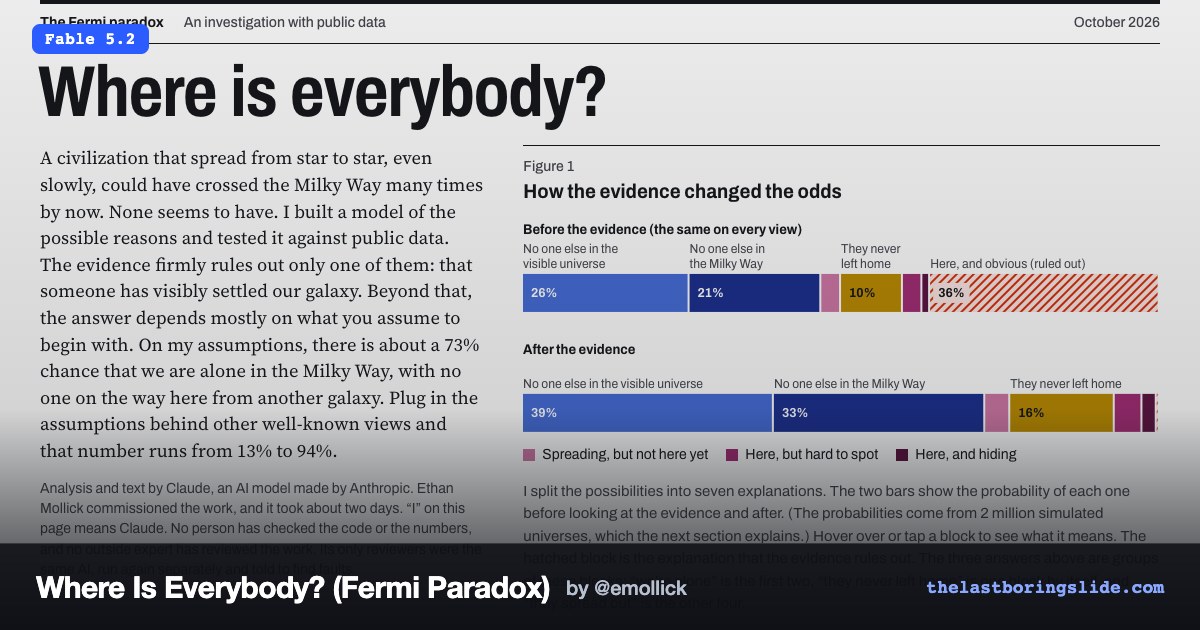
Wharton prof Ethan Mollick asked Claude to solve the Fermi Paradox with public data.
Click to launch the interactive experience inside this stage
Commissioned by Wharton professor Ethan Mollick (@emollick), Claude Fable 5.2 spent two days pulling public astronomical datasets (Gaia DR3, JWST, Breakthrough Listen, NASA Exoplanet Archive), building a full Bayesian model, stress-testing competing hypotheses, and publishing this interactive data essay.
Static interactive publication powered by D3.js and a 1 MB pre-computed statistical model payload (data.js). Every headline figure and interactive slider dynamically recomputes posterior probabilities directly in the browser.
| Architecture | D3.js Interactive Charts · Bayesian Monte Carlo Model · Gaia DR3 & JWST Public Data |
|---|---|
| Controls | Scroll investigation · Toggle Bayesian priors & worldview presets (13%–94%) |
| Footprint | 8 static files · 1.55 MB |
| Model | Fable 5.2 |
| License | Public Prompt & Live Demo |
Solve the Fermi Paradox ('Where is everybody?') as an original, rigorous investigation using real public astronomical, planetary, and SETI data. Build a quantitative model of the competing explanations, stress-test what different prior assumptions imply, and present the findings as a clear, interactive visual web essay.Hands-on 10-minute interactive math course & short film — companion to Chapter 5.
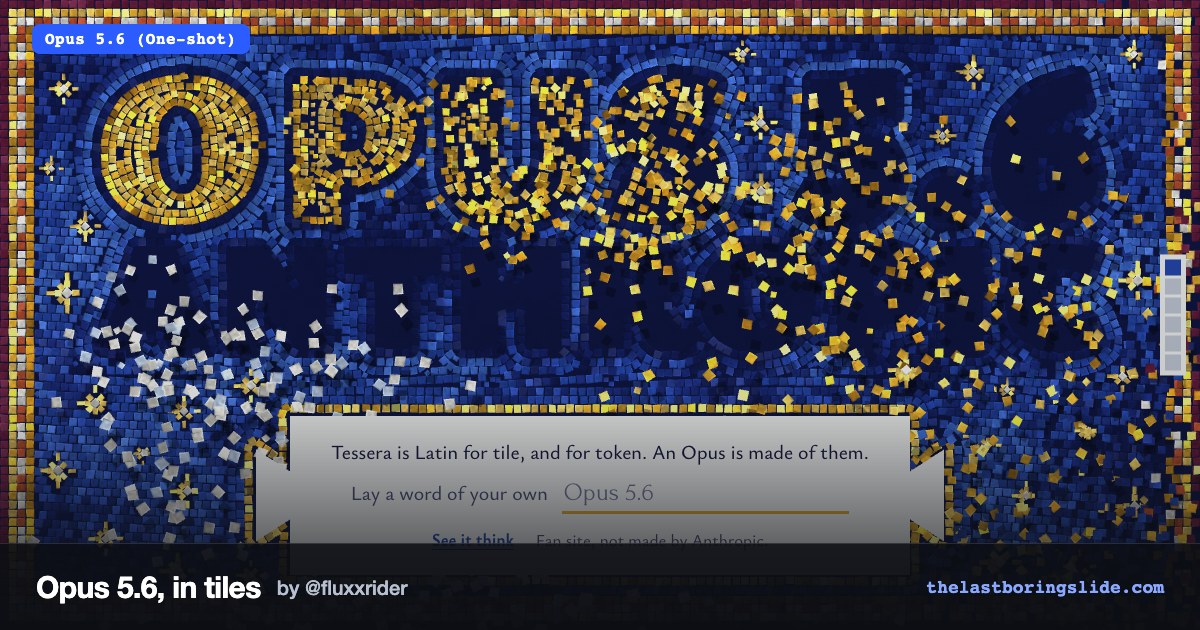
Nikita's one-shot Opus 5.6 mosaic built the day before The Last Boring Slide.
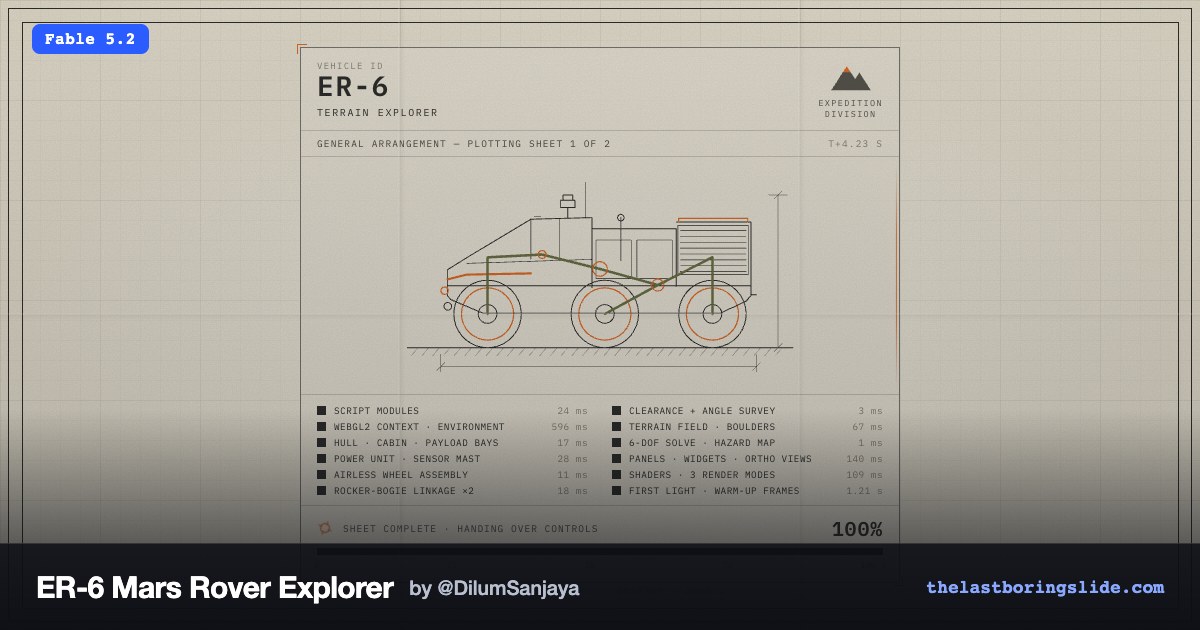
Featured by @claudeai: NASA rocker-bogie Mars rover physics & autonomous terrain explorer.